I’m currently reading the book, What the Robin Knows: How Birds Reveal the Secrets of the Natural World, by Jon Young, which is about awakening our awareness of the behavior of birds in order to deepen our connection with all the wildlife surrounding us. Ultimately, the author is helping us to reconnect with our own animal senses, teaching us to be one with wildlife instead of being a disturbing presence. Through learning to be more animal-like ourselves and tuning into the messages the birds are constantly sending, we’ll begin to see more of the wildlife that typically eludes us.
The concept from the book that is speaking to me the loudest at this point is the idea of finding a “sit spot”. This is a place near your home, ideally in the backyard, that you visit daily at the same time for at least twenty minutes or longer. The sit spot doesn’t need to be in your backyard, but needs to be somewhere convenient, nearby, and easy to get to. The author suggests it shouldn’t be more than a two minute walk from home. A nearby park could easily work. I also suspect the balcony of an apartment would be sufficient, as long as there are feeders set up to attract the birds. The key is to visit this spot daily, so the birds will become used to your presence and begin to act naturally around you.
This is something that my 5-year-old and I have already been doing, but we’re now learning, through this book, to take our bird watching to an entirely new level. My son already asks to sit in the backyard every day for anywhere between 10 to 30-minutes at a time. For anyone who knows my super-active kid, this is pretty amazing in itself. But he sits there quietly, not saying a word, being as still as he possible can, so the birds will go about their normal activity while he watches. Daily, he tells me about the cool animals and behavior he’s witnessing in our backyard. I regularly hear things like, “There’s a new bird in our backyard today. It has a black head, a reddish back and brown body, and white stripes on the tail.” This was a new bird he spotted this past week, now a regular visitor to our yard.
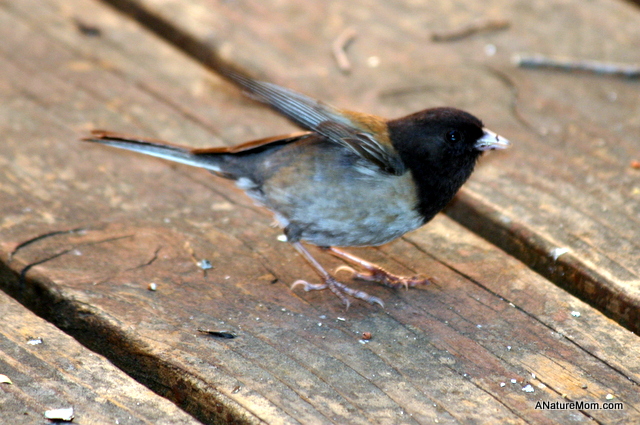
My son pointed out that it was acting just like the towhees that hang out in our yard, hopping around on the ground and in the shrubs. I had no idea what it was, but we’ve since learned it’s a Dark-Eyed Junco (or Oregon Junco). We’re learning together, which is a cool thing. In the future, I’m going to join him or have my own solitary sit spot time. So far, I’ve been sitting in the yard watching the birds a few times a week. I love it when I do make the time for it. Making it a daily habit sounds even better… meditative, even. It’s a practice in being completely present, opening all the senses to be aware of all that’s going on in the environment.
So, how does a sit spot work? In addition to sitting there watching what the birds are doing, you have to open your ears, too. We tend to only notice the loudest bird call or the loudest noise in the neighborhood. There’s usually a lot more going on than what we tend to focus on. Listen closer. Listen to the quieter birdsong or the scratching noises in the shrubs. Notice how the birds are communicating with each other. It’s pretty cool once you begin to notice the intricacies of their language. Also observe how they react to other sounds, such as the garbage truck driving down the street or a plane flying overhead. What did the birds do when you heard the call of a hawk overhead? And, is that hawk call really a hawk? The stellar jays do a great impersonation! Pay special attention when the birds go completely quiet. Something’s happening. Birds communicate when predators are near… fox, coyote, hawk, bobcat, etc. Once we understand bird language better, we may begin to see more of these stealthy creatures.
But first, we need to learn a “routine of invisibility” and “fox walking”. The book teaches the skills necessary to blend in with the other animals and not act like a noisy, intrusive human. I’m not going to delve into that here, but it’s fun to read about. I look forward to practicing these behaviors on future walks.
For now, we’re focusing on improving our sit spot and our observation skills. We’ve set a couple chairs in a corner of the yard, so we’ll be less intrusive. We’re working on our “fox walking” so we won’t create such a huge disturbance while walking from our backdoor to the sit spot. And, most importantly, we’re learning to open our ears and widen our sight to include the entire view and chorus surrounding us. Try it! It’s fascinating.


 The Tangled Trail
Please Comment